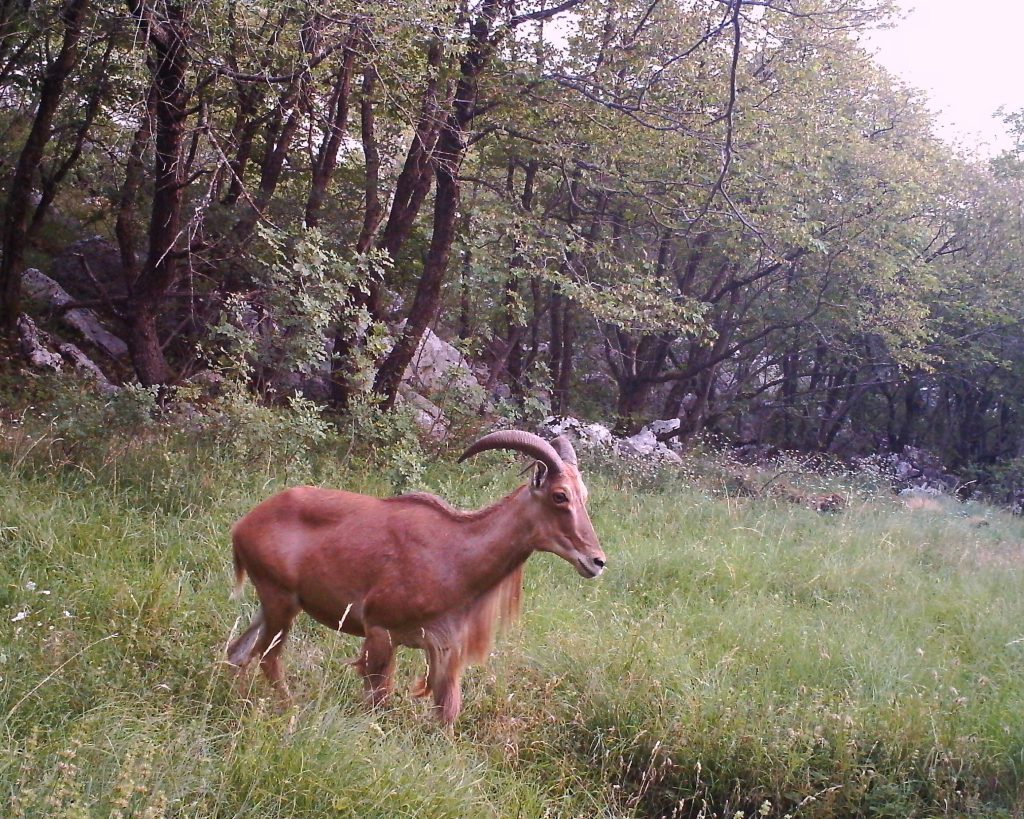
New Scientific Publication by FEP Colleagues on the Effects of Dry Conditions and Predation Risk on the Spatial Behaviour of Introduced Aoudad in Croatia
A scientific article titled “Dry conditions and predation risk shape the spatial ecology of introduced aoudad” has been published in the European Journal of Wildlife Research. Dr. Konstantinos Papakostas, a new staff member of the Faculty of Environmental Protection, contributed to the article as corresponding author. The research was led by colleagues from the Faculty of Agriculture, University of Zagreb, Professor Dr. Nikica Šprem and his research group, with whom FEP has maintained successful cooperation for many years, particularly in teaching and in research on wild ungulates.
The study examines the spatial ecology of the introduced Barbary sheep, also known as aoudad (Ammotragus lervia), in Mediterranean Croatia. Based on GPS telemetry data, the authors analysed animal movement, home-range size, and habitat selection in relation to dry conditions, environmental characteristics of the area, and predation risk.
The findings show that the spatial behaviour of the species changes according to seasonal and environmental conditions. The monitored individuals primarily selected higher elevations and steeper slopes, while their activity areas were considerably smaller during the warmer part of the year. This may be linked to the search for more favourable microhabitats under dry conditions.
The publication contributes to a better understanding of the behaviour of this introduced species in Mediterranean areas and supports more effective population management under changing environmental conditions.
The full article is available HERE.