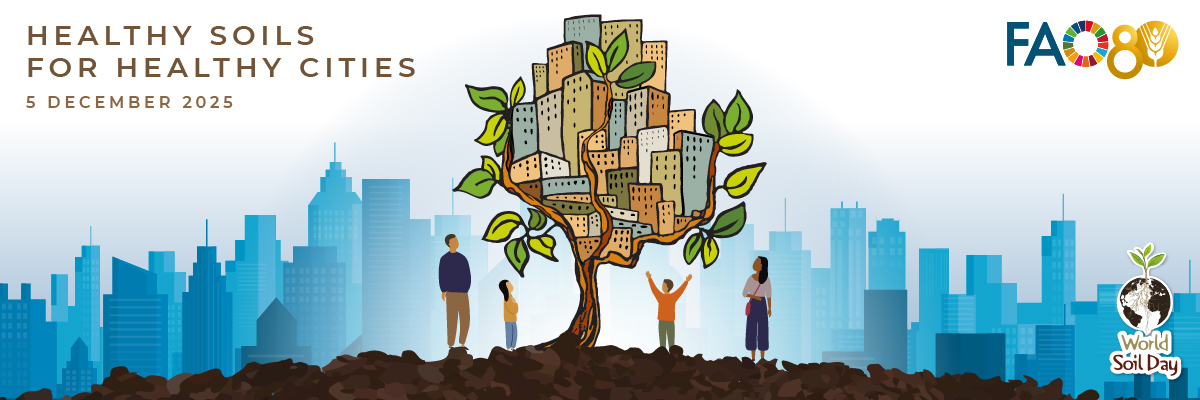
World Soil Day is celebrated on 5 December. It was established in 2014 under the umbrella of the Food and Agriculture Organization of the United Nations (FAO) with the aim of raising awareness about the vital importance of soils for humanity. The date is not accidental – 5 December marks the birthday of the late Thai King Bhumibol Adulyadej, one of the world’s most prominent advocates of sustainable soil management.
This year’s slogan, Healthy Soils for Healthy Cities, highlights that the quality of life in urban environments depends not only on buildings, infrastructure, and spatial planning, but also on the condition of soils, which are often hidden beneath urban surfaces. Healthy urban soils regulate the retention and circulation of (rain) water, reduce the heat island effect, moderate temperature, store carbon, and contribute to cleaner air and overall well-being. When soils are covered with cement and other impermeable materials, they lose these functions, making cities more vulnerable to flooding, overheating, and pollution. As urban soils are among the most stressed and degraded soil types, World Soil Day calls upon everyone – from decision-makers and urban planners to local communities and individuals – to look at cities differently, “from the ground up”, and contribute to creating greener, more resilient, and healthier urban environments.
Soils are the foundation of our survival—they enable food production (over 95% of our food originates from soils), filter, enrich, and store water, regulate the climate, and support an extraordinary diversity of organisms. Yet in everyday life, they are often overlooked or taken for granted. Precisely because they are largely invisible in the landscape, soils are among the most vulnerable natural resources.
|
At the Faculty of Environmental Protection, we therefore place strong emphasis on soil science in both research and education. Within our study programme, we have dedicated an entire module to soils, offering the courses Environmental Geochemistry and Soils and the Environment. The reason is clear—research shows that soils receive too little attention in primary and secondary school curricula. As a result, pupils and students often do not gain sufficient understanding of the significance of soils for the environment and society. Studies also confirm that early exposure to soil-related topics significantly increases the likelihood that young people will pursue educational and professional paths in soil science. For this reason, our faculty is committed to providing students with in-depth, expert, and responsible education, as they may be the ones shaping key decisions about the management of our most precious natural resource – soil. |
On the occasion of World Soil Day, the Slovenian Soil Partnership is organising an online event dedicated to knowledge exchange, presentation of good practices, and connecting experts, researchers, and other stakeholders working in the field of soils. The programme will feature topics such as the psychological aspects of green spaces in cities, planning healthy and walkable living environments, soil protection and guidance of recreational use in urban forests, and soil classification in Slovenia, presented by FVO colleague Dr Borut Vrščaj.
The Slovenian Soil Partnership was established on World Soil Day in 2017. Its mission is to raise awareness and contribute to the sustainable management and protection of soil as one of the most important non-renewable natural resources in Slovenia.